Showing posts with label diet. Show all posts

Wednesday, March 12, 2014

Breaking up with conventional thinking on nutrition

I'm not trying to be all negative here, but I'm starting to get the feeling that we have got it all wrong.

My husband and I watched Cosmos last night, hosted by Neil deGrasse Tyson. I loved how he emphasized how dedicated science is to follow where the evidence leads. Except when it comes to nutrition, I guess.

Here are some revelations I have discovered in my nutrition awakening, relevant only to what I previously believed:

1. You have to limit fat if you want to lose fat.
FALSE. Limiting dietary fat is no fun and is largely unsustainable. Instead, try limiting carbs, which will subsequently lower insulin production (the hormone responsible for triggering fat storage). Of course, you shouldn't outeat your true energy needs no matter your macronutrient ratios. Fat is amazing. It tastes great. And if you can change your metabolic pathways to better utilize fat for energy, fat can be so beneficial in curbing hunger, providing sustained energy, and burning fat.

2. Every meal should be a balanced meal.
NOT REALLY. It kind of depends on what your body needs. If you need some quick energy (as an efficient fat burner), you should go for some medium-chain triglycerides or saturated fat, such as coconut butter, butter, coconut oil, and palm oil. If you need micronutrients, you should go for chia seeds, avocados, asparagus, spinach... Carbohydrates are the only non-essential macronutrient. We would die without dietary fat. Same for protein. We would function just fine without carbohydrates. The body has other mechanisms for creating glucose, which is essential for a small portion of the brain.

3. It's best to eat small meals throughout the day.
NOT IF YOU CAN BREAK YOUR CARB ADDICTION. While this may be true for the majority of the population that depends on the quicker burning (non-essential) carbohydrate diet, this is good advice. If you are working with mostly fats, then your meals will naturally be small (fat packs in a lot of calories), but you can (and should) go for at least 5 hours in between meals. Some people even try intermittent fasting (IF) and do just fine.

4. Breakfast is the most important meal of the day. 
AGAIN, TRUE FOR CARBERS. NOT TRUE FOR EFFICIENT FAT BURNERS. The reason that carbers should never skip breakfast is because their body is at the whims of the blood glucose cycle. Your body needs to replenish the glucose stores it went through during the night. If you don't replenish these supplies, you can land yourself in big trouble (read: famished by lunch, craving carby foods and further exacerbating the cycle). However, if you train your body to use fat for fuel, you will efficiently burn stored fat throughout this morning period without getting super hungry and without losing energy. This is freeing.

5. If you skip meals, your body will go into "starvation mode."
KIND OF TRUE, BUT MISREPRESENTED. Starvation mode is the amazing mechanism of our bodies turning to stored fat for fuel. But your brain needs some glucose, so it will use some stored glucose for that ~20% brain function that relies on glucose (the rest can use a byproduct of fat breakdown called ketones). If need be, your body can bust into lean muscles and tissues for protein, and create glucose from it, called gluconeogenesis. If you are already an efficient fat burner, "starvation mode" makes little difference. See the previous point about skipping breakfast. You should eat. Your body needs fuel eventually, and you do NOT want to start metabolizing muscle and tissue.

Until recently, I was participating with a group of health coaches promoting the low-fat, high-carb, restricted calorie lifestyle. I think this approach is one that will work for many people who lack the discipline to stay away from carbs and realize that they "like" carbs because carbs stimulate pleasure in the brain--let's think of other ways to do this! But if we are going to really educate people, we should be screaming from the mountaintops: There is no one size fits all approach! And if there were, it would certainly not be a high-carb, low-fat approach. Calorie restriction and low-fat, high-carb usually does not work long-term, and it certainly isn't working as a societal recommendation.
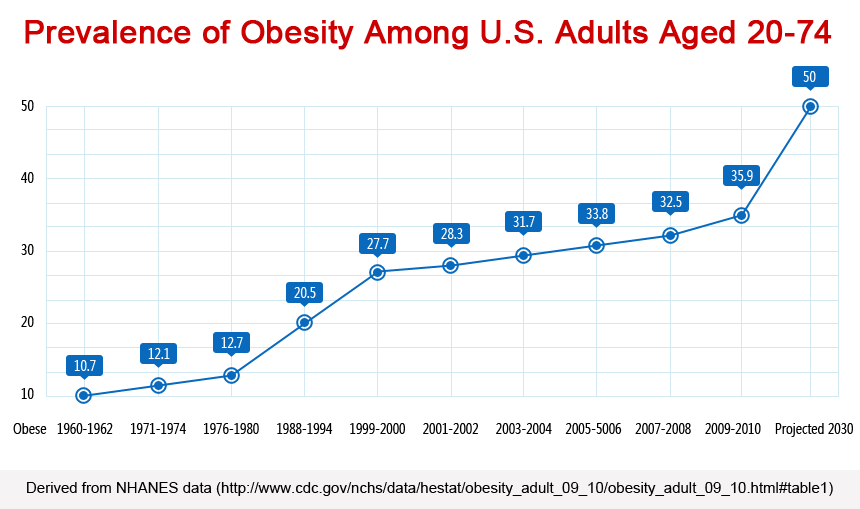
It can work short-term, and it can work for people with the right kind of genes to handle all those carbs, but I am convinced that our dietary guidelines should be steered to a lower carb approach. Maybe 60% of calories from fat, 15% from carbs, and 25% from protein.

For your entertainment, here are a few gems of the "fuzzy math" of nutrition being promoted by self-titled health coaches:
  • Your body turns protein and fat into glucose. Huh? Since when? Your body turns carbs into glucose at very high rates, turns 30-50% of protein into glucose (which is why you shouldn't overdo protein), and, in rare circumstances, can turn as much as 10% of fat into glucose (like, if you have been running for 40 hours and have run out of glucose stores and you broken down a significant amount of muscle and tissue--not a common scenario).
  • Complex carbohydrates are called as such because they have protein in them. Yeah, that's not really how the naming convention works in science. It's based on the structure of the carbohydrate molecule, and how complex it is compared to a simple sugar. Nothing to do with protein. 
  • You should eat 1.5 g of protein per pound of body weight. OK, all you are doing here is providing an excess of protein to be turned into glucose. Good job. The recommendation on this one is pretty sound, actually (about 54 g of protein for a 150-lb adult; not at least 54, but 54). It's mostly comes from the performance oriented goals of sports nutrition science. As a caveat, if you are truly building muscle, then your protein needs will be a bit greater. Also--a good benefit of protein is that is slows digestion and hence, makes you feel full. An overage of protein can stop up the works. The best approach to calculating your protein needs is to start with your bodyweight, and from there, account for any significant muscle-building you are consistently doing.
And while we are on the subject of protein, all of these protein-pushers may be making a quick buck on the trend now, but some new research even suggests that a surplus of protein might have detrimental health effects.

Unfortunately, I don't think there's as much money to be made from promoting a high-fat, low-carb, moderate protein lifestyle. Protein is expensive and has many allies (meat and soy industry, nutrition companies that are on the protein bandwagon), carbs are a cash cow for the food industry (cheap to make and you can rely on people's cravings for them), and are especially lucrative when you throw a "low-fat" banner on the label.

Where's the money to be made in promoting whole foods that naturally promote less consumption, like olive oil, butter, green vegetables, coconut milk, etc... ? In this approach, you would need to eat a lesser amount of food, as your energy is mostly coming from fats, which pack more that 2 times the amount of energy per gram than protein or carbohydrates. Instead of a huge, $15 salad with fat free dressing and chicken, you could have what I had today: 2 eggs cooked in coconut oil plus 1/2 an avocado. Last night I fasted from 4pm to 11am this morning and felt totally sustained. Not to mention my blood sugar stayed on a straight path between 75 and 110 all day. Pretty good for someone with a dysfunctional pancreas. And for someone living in a country with dysfunctional thinking on nutrition.


Thursday, February 27, 2014

Going rogue... with the guidance of a medical professional

Ever have one of those moments where you decide to act upon something you have been thinking about for a long time? Well, I'm having one of those moments. It feels like I'm breaking out of prison.

Fine, I'm not batting 1.000 as one member of tudiabetes.org put it. We will see what my next A1c is. I can't be sure it's amazing, but I do know that I have been AT EASE for the past 3 weeks. Ever since Feb. 7, the day before my birthday, when I decided to break up with carbs.

The moment I spoke of before was not deciding to break up with carbs, but was the moment I went into my online health portal and CANCELED all my appointments. It was symbolic, of course, because I can always go back in and reschedule them. But still...

So, here's a breakdown of how everything has been since then:
I went to see this holistic doctor. I had seen him before. Before I was on the University of Michigan's HMO, when I was still on COBRA and I would have had to pay outright no matter where I went. But when I jumped on the UM HMO, I made decisions based on what would be covered. So, instead of seeing the doctor I wanted to see, I ended up with 5 doctors that I didn't want to see: a PCP, 2 endos, a pump specialist, and a nutritionist. All with a copay of $20-30, so I didn't even end up saving anything! (The holistic doc charges $105 per visit.)

UNSOLICITED ADVICE: Paying out of pocket for GOOD medical care is a much sounder financial decision than paying copay after copay for BAD medical care. 

Here's what I liked:
  1. He gave me a hug when he saw me, and upon parting (warm fuzzies!)
  2. He has a dog in the office that is super friendly 
  3. He is willing to say "I don't know" when he doesn't know (unlike, ahem, some people in the diabetes clinic who would rather spout off 45 minutes of 100% grade A bullshit than admit they don't know). 
  4. He's totally on board with low-carb (He said, "Anyone who isn't on board hasn't read the literature in the last ten years). I happen to think they are unwilling to depart from the old ADA guidelines, even though ADA has now updated their guidelines to say that, in fact, there isn't a one-size-fits-all approach to carb intake, and even reference studies with 20g daily carb up to 40% of calories from carb as having great impact on glycemic control. 
  5. He's going to "go rogue" with me... ie: be there to give me sound medical advice, but not treat me like a number (test result number). He told me to still see my endo, and I told him, fine, but I'm just going to smile and nod and then go off and do what I feel is right. 
  6. He isn't going to designate me as a "high-risk" anything, because I'm not high risk. My numbers are good. I'm super healthy. I don't need to be cradled and babied just because I have type 1. I can experiment with things like diet and exercise and that's OK. I don't have to sit still all day and nibble on three meals and three snacks throughout the day and eat the same thing and never try anything new.
And now, for an update on my BGs:
It's a bit rocky (by my new standard) today because I am entrenched at work with a deadline. Finally got my report in, and my CGM didn't beep at me all day, so I only just now looked at it.

Funny--when I first got it, I was OBSESSED. I looked at it all the time. And was often surprised at what was happening. Now I kind of assume my BG is in range.

Friday, February 7, 2014

Everything they tell you about nutritional guidelines is wrong.

I don't know why this rubbed me the wrong way so much:

I went to see a dietitian in the Metabolism, Endocrinology, & Diabetes clinic. I went in with a chip on my should already, because what could SHE possibly have to tell ME that I didn't already know after 18 years of living with type 1 diabetes for 18 years?

We started by going through my typical day of eating and looking at my blood sugars (rocking out at HbA1c = 6.4), and all she had to contribute was "good job."

She told me that "you should be eating at least 130 grams of carbs per day."

"OK," I told her, "I'll dip into a jar of jelly beans every night before I go to bed. That should do it."

Then she started explaining that they should be whole grains, spread throughout your meals and snacks. She spouted the typical dribble I've been hearing my whole life: 30-45g of carbs with every meal, 15g for each snack.

I asked WHY? Why do we need to consume at least 130g of carbs each day? And that kind of implies that it's a minimum, and we should REALLY be doing MORE, which goes against everything I believe in. (Aka: Americans are fat because they eat wayyyyy too many carbs, and if anything, we should be giving them a maximum, not a minimum.)

Your brain needs glucose for fuel--that was her explanation. I've heard that many times before, including from my health coach who approaches nutrition from a more reasonable stance, IMO, and advises 3 servings of whole grains per day--that's it.

SO... I started looking into it. Does our brain rely solely on glucose for energy? And if so, how much? Where do these guidelines come from? I'll start there.

1. Where do the guidelines come from? (The recommendation of at least 130g of carbs daily.)
Answer: From the FDA. Research shows that in a typical diet, the brain uses glucose (all carbohydrate breaks down into glucose with the exception of dietary fiber). They came up with this recommendation based on how much glucose the brain needs at a minimum for a good, functioning brain. Good rec, right? Well, in the report that outlines these guidelines, they also reference studies showing that, actually, the brain can use another source for fuel: ketone bodies. Ketone bodies are made when breaking down fat or drawing on stored fat for energy. We all make ketones when we are fasting (like overnight), and it is a comparable, arguably better, source of energy for your brain.

Before 1921, when the late great Fred Banting discovered insulin (the best discovery of all time), people with "sweet death" could prolong their lives for weeks or months by consuming zero carbohydrates--they ate mostly fat, and a bit of protein. So...

2. Does the brain rely solely on glucose for energy? NO. A resounding NO. We just don't understand the alternate process enough to feel good about recommending it. I'll give it a try:

There are a few parts of the brain that rely only on glucose, but we can actually convert protein into glucose for those purposes. So, do we NEED carbohydrates to survive? Nope. It's the only of the 3 macronutrients that we DO NOT need.

So, given that we will inevitably eat a few carbs no matter how hard we try, and we will definitely eat some protein, those parts of the brain are covered. The rest of the brain and the body (muscles and all), can rely on dietary fat. The brain (parts that don't require glucose) can use something called ketones, which are made in the liver when breaking down fats. This only happens on a large scale when there is little to no carbohydrates available, and insulin levels are nil in the bloodstream.

Your cells, including your muscles, are perfectly happy using fat for energy, and your brain will use ketones. A bit of protein will help your muscle development and some will convert into glucose for your brain.

Cholesterol seems to be a problem only for folks who consume too many carbs and store fat (especially saturated fat), but when eliminating carbs, this isn't a problem.

I heard about a man in Australia who takes one daily shot of basal insulin (6 units!!!!) and does not see many fluctuations in his blood sugar levels.

Check it out: http://www.youtube.com/watch?v=TR8rc_AF6XU 

So here I am: 18 years in and just hearing about the ketogenic diet. I'm all in.

Day 1 (today)
Breakfast: Cheesy 3-egg omelet cooked in a generous amount of coconut oil with a latte made with soy milk creamer. 0.9 units for a bolus, and my basal rate is set at 50% of my normal regime.